The cross product is an operation that takes two vectors in
and returns another vector in
, written . Unlike the dot product, the result is a vector, not a scalar. The cross product is only defined in three dimensions (and in a generalized sense in seven dimensions; here we restrict to ).
Geometric meaning
- Direction: is perpendicular to both and , following the right-hand rule: if you point your fingers along and curl them toward , your thumb points in the direction of .
- Magnitude: , where is the angle between and . So the length equals the area of the parallelogram spanned by and .
Algebraic definition
For vectors
the cross product is
This can be remembered using the determinant of a formal matrix:
where are the standard unit vectors in .
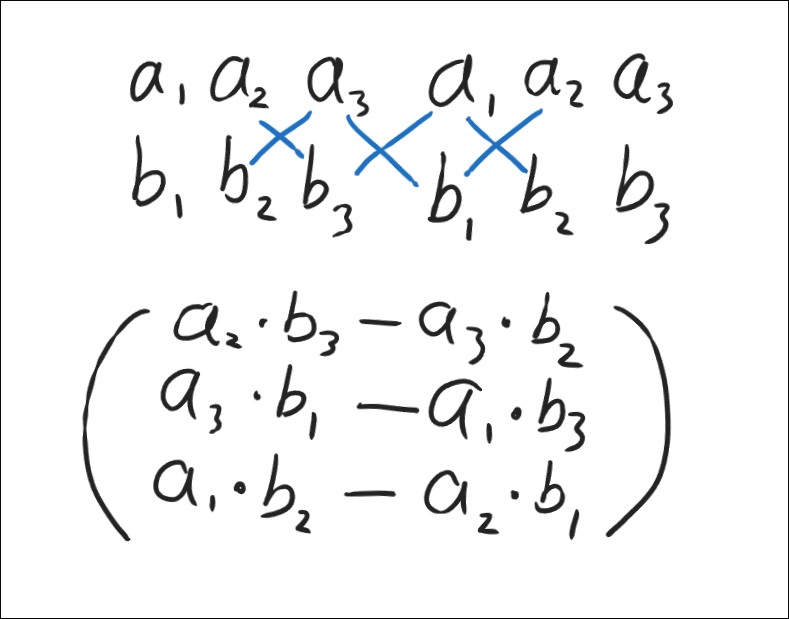
The “Cross-Out” Method (Fastest)
The shorthand calculation for this is:
- Stack them: Write the components of the first vector over the second vector twice.
- Cross out the first and last columns.
- Multiply in an ‘X’ pattern (top-left bot-right minus top-right bot-left) for each remaining pair:
Rules of calculation (with examples in LaTeX)
Let and .
1. Anticommutativity
Swapping the order flips the sign:
Example:
2. Distributivity over addition
Example (second component of ):
3. Scalar multiplication (homogeneity)
A scalar can be factored out of either slot:
Example: with , , ,
4. Cross product with the zero vector
5. Parallel vectors
and are parallel (or one is zero) if and only if
Example: , , so
6. Self-cross product
(Special case of the parallel-vectors rule.)
7. Jacobi identity
8. Relation to dot product (vector triple product expansion)
Example: , , :
9. Magnitude and angle
Equivalently, .
10. Relation to the dot product (scalar triple product)
This value is the (signed) volume of the parallelepiped spanned by . Example:
Worked example
Compute for
Check: , and , so the result is perpendicular to both and .